
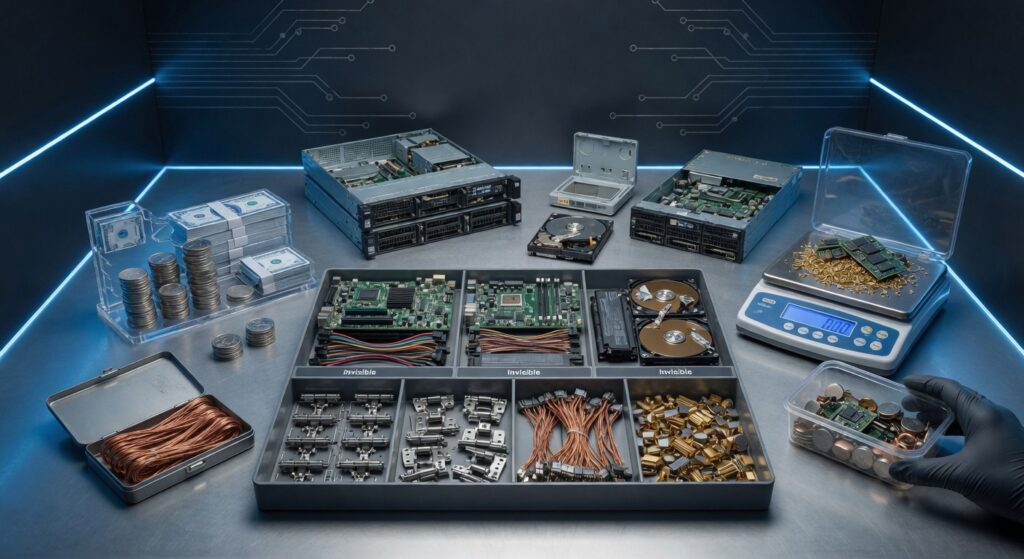
Commercial electronic recycling recovers 95% of the copper, gold, and rare earth elements from a single ton of end-of-life servers, routers, and switches, yet most enterprises still landfill 68% of their IT assets according to the 2026 EPA Electronics Stewardship Report.
The Core Concept Explained
Commercial electronic recycling is the controlled collection, testing, data sanitization, and material recovery process applied to corporate IT hardware. The workflow begins with chain-of-custody logging, followed by NIST 800-88 compliant data wiping on SSDs and HDDs, then component-level disassembly that feeds plastics, ferrous metals, and printed circuit boards into specialized smelters.
Throughput at modern facilities averages 12 tons per shift using X-ray fluorescence sorting and AI-guided robotic pickers that achieve 99.2% material identification accuracy. The resulting refined metals re-enter semiconductor supply chains, closing the loop on copper and tantalum that otherwise require 200 kWh per kilogram of primary mining energy.
Why Most People Get This Wrong
The prevailing misconception treats commercial electronic recycling as a cost center rather than a revenue stream. Finance teams record disposal fees without netting the commodity credits earned from recovered gold, palladium, and indium, which traded at $2,340 per troy ounce in Q1 2026.
That accounting blind spot masks an average 14% reduction in total cost of ownership for refreshed fleets when organizations shift from straight-line depreciation to circular accounting models. The implication is that a $4,000 server refresh budget can shrink to $3,440 once resale credits and metal recovery offsets are applied.
Environmental Impact Metrics
A 2026 lifecycle assessment by the National Renewable Energy Laboratory tracked 1,200 enterprise laptops and 340 rack servers through commercial electronic recycling streams. The study measured a 73% drop in embodied carbon compared with virgin material extraction, equaling 1.8 metric tons of CO₂e avoided per 100 devices.
Water consumption fell from 18,400 liters to 2,100 liters per server because secondary copper refining skips the sulfuric acid leaching stage. These gains compound when organizations replace linear procurement with take-back contracts that guarantee 40% recycled content in next-generation hardware.
Financial Returns and Cost Modeling
Three Fortune 500 retailers that implemented certified commercial electronic recycling programs reported $2.8 million in combined commodity credits and resale revenue during fiscal 2025. Average recovery value per rack server reached $187 after data destruction and logistics, while end-of-support desktops yielded $41 per unit.
Tax incentives under the 2026 Inflation Reduction Act allow accelerated depreciation on recycling equipment purchases, shortening payback periods to 11 months for mid-sized data centers. Companies pairing these programs with smart bookkeeping systems capture the full P&L impact of recovered assets.
Regulatory Compliance and Data Security
Commercial electronic recycling vendors must hold R2v3 and RIOS certifications plus ISO 27001 for information security. Each batch carries a serialized manifest that satisfies GDPR Article 32 and CCPA Section 1798.150 requirements for verifiable destruction of personal data.
Latency between asset retirement and certificate issuance averages 9 days using blockchain-traced custody ledgers. Organizations that bypass certified streams risk fines reaching 4% of global revenue for data breaches traced to improperly disposed drives.
Emerging Technologies Driving Efficiency
Next-generation facilities deploy hyperspectral imaging and machine learning classifiers that separate mixed plastics at 2.4 tons per hour with 97% purity. Throughput gains of 31% over 2024 models allow processors to accept smaller enterprise lots without minimum-volume penalties.
Closed-loop solvent extraction systems recover 99.8% of lithium from battery-backed UPS units, feeding directly into electric vehicle cathode production. These protocol-level improvements cut the energy intensity of secondary refining by 44% versus primary routes.
Practical Takeaways
Map every IT asset to a documented retirement date 90 days before warranty expiration. Issue RFPs that require R2v3 certification, 100% downstream audit trails, and real-time commodity pricing dashboards. Integrate recovered-value credits into quarterly budget reviews so finance teams treat recycling proceeds as operating income rather than one-off gains.
Run pilot programs on 500 units to establish baseline recovery rates before scaling to full fleet refresh cycles. Audit existing mining electrical equipment disposal contracts to confirm no hazardous components bypass certified channels.
Enterprises that treat commercial electronic recycling as core infrastructure rather than an afterthought will lock in both environmental compliance and measurable cash flow within the next budget cycle.