

Mobile analytics tools have become indispensable for app developers, marketers, and product managers navigating the competitive app ecosystem in 2026. With over 257 billion mobile app downloads annually and millions of apps competing for user attention, understanding what happens inside your application has never been more critical. These sophisticated platforms have evolved far beyond simple download tracking, now offering deep insights into user behavior, technical performance, and revenue optimization that directly impact app success.
The mobile analytics landscape in early 2026 presents a mature market with specialized solutions for different needs. Whether you’re tracking user journeys, optimizing marketing campaigns, or monitoring technical performance, choosing the right analytics tool can literally make or break your app’s growth strategy. This comprehensive guide explores the leading mobile analytics platforms available in 2026, examining their unique features, pricing structures, and ideal use cases.
Understanding Mobile Analytics in 2026
Mobile analytics involves collecting, measuring, and analyzing data about how users interact with mobile applications. Modern platforms capture granular behavioral data including user flows, feature adoption rates, conversion paths, session recordings, heatmaps, crash reports, and revenue attribution across the entire customer lifecycle.
These tools work by integrating a Software Development Kit into your mobile application. Once implemented, the SDK automatically collects data about user interactions, technical performance metrics, and business outcomes, presenting them through intuitive dashboards that help teams make data-driven decisions.
Top Mobile Analytics Tools for 2026
UXCam – Best for Mobile Product Analytics
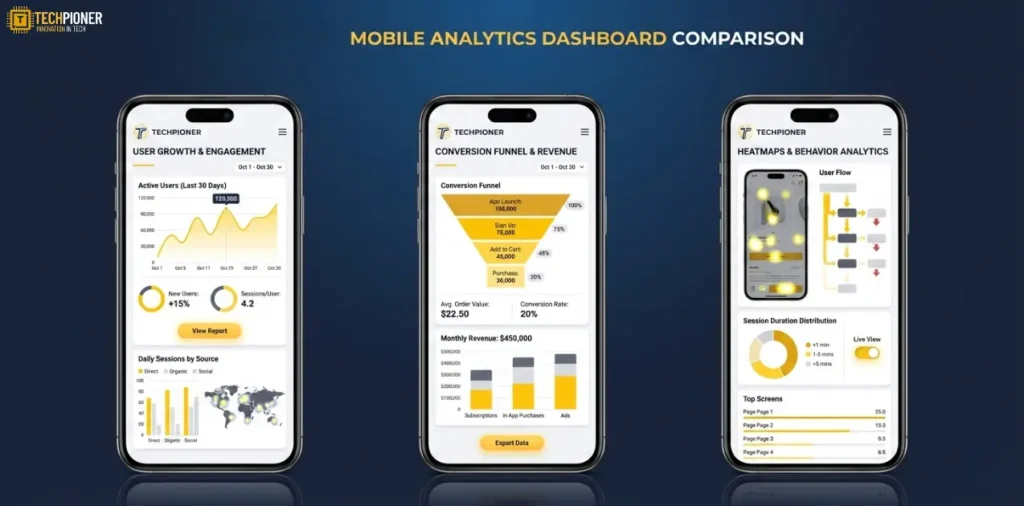
UXCam leads the product analytics space in 2026, providing deep qualitative and quantitative insights into mobile app experiences. The platform excels at capturing micro-interaction data that goes beyond vanity metrics, helping teams understand not just what users do, but why they do it.
The standout feature is session replay capability, which records actual user sessions showing exactly how people interact with your app. Unlike traditional analytics showing only aggregated data, session replays let you watch individual user journeys, seeing every tap, swipe, and gesture. This proves invaluable when investigating usability issues or discovering unexpected use cases.
UXCam’s heatmaps provide visual representations of user interactions, quickly revealing which elements attract attention and which are ignored. The platform offers robust funnel analysis, event tracking with customizable parameters, and automatic crash detection correlated with user sessions. Pricing is based on monthly sessions recorded, with plans suitable for startups through enterprises.
Firebase Analytics – Best Free Mobile Analytics Solution
Firebase Analytics remains the go-to choice for developers seeking powerful analytics without upfront costs. As a completely free solution with no session or event limits, Firebase democratizes access to professional-grade analytics that were once available only to well-funded companies.
Firebase excels in its deep integration with the broader Firebase ecosystem. Teams using Firebase for backend services, crash reporting, or cloud messaging benefit from seamless data flow across tools. This integration enables sophisticated workflows like targeting push notifications to specific user segments based on analytics data.
The platform automatically captures standard events like app opens, screen views, and in-app purchases with minimal setup. Developers can define unlimited custom events for application-specific actions. Firebase’s machine learning integration predicts user behaviors like churn probability and potential spending, allowing proactive intervention. Integration with Google Analytics 4 provides additional analysis capabilities and unified mobile-web data viewing.
Mixpanel – Best for Event-Based Analytics
Mixpanel pioneered event-based analytics and continues leading this category in 2026. Unlike traditional analytics focusing on page views and sessions, Mixpanel allows teams to track and analyze any user action as a discrete event, providing unprecedented flexibility in understanding user behavior.
The platform’s powerful query interface empowers both technical and non-technical team members to explore data freely. Users can build complex analyses combining multiple events, properties, and user attributes without writing SQL queries. This democratization means product managers and marketers can answer their own questions rather than queuing requests with data teams.
Mixpanel’s funnel analysis capabilities are among the industry’s most sophisticated. Teams can create multi-step funnels with conditional logic, compare conversion rates across segments, and identify characteristics of users who complete versus abandon critical flows. Real-time data processing enables monitoring campaigns and product launches as they happen. Pricing is based on monthly tracked users, with a free tier covering up to 20 million events and 1,000 monthly tracked users.
Amplitude – Best for Predictive Analytics
Amplitude has built its reputation on sophisticated behavioral analytics and industry-leading predictive capabilities. The platform forecasts what will happen, helping teams make proactive decisions rather than reactive ones.
At Amplitude’s heart is its behavioral graph, a comprehensive map of how users interact with your app over time. This powers advanced analyses like behavioral cohorts, grouping users based on action sequences and timing. The platform’s predictive analytics use machine learning trained on historical data to forecast future outcomes, predicting which users will likely churn or make purchases. For comprehensive app store optimization alongside analytics, platforms like ASOMobile complement behavioral tools by improving app visibility and discovery.
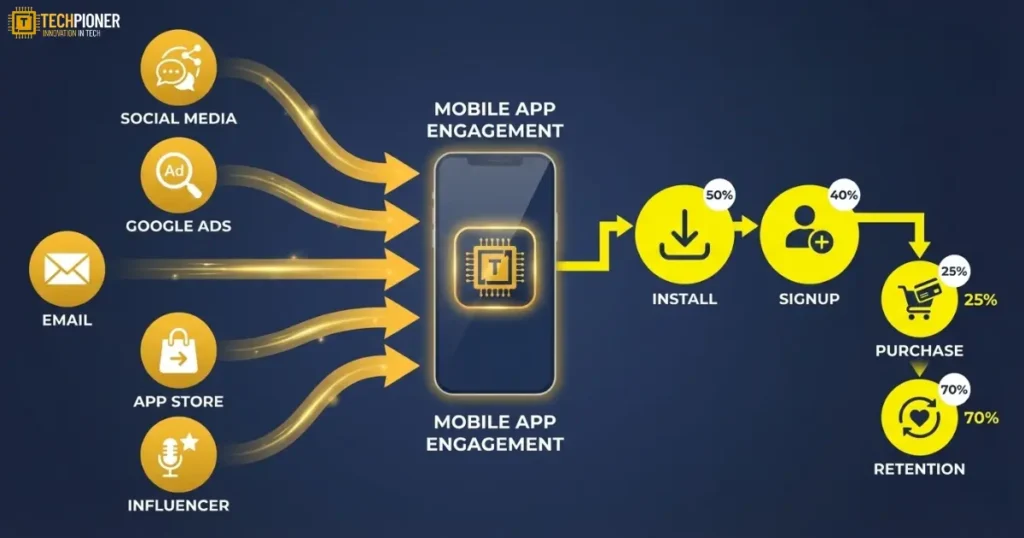
Amplitude’s pathfinder analysis visualizes common user paths through your app, revealing popular journeys and unexpected navigation patterns. Impact analysis quantifies how specific features affect key business metrics, helping prioritize development. The platform offers robust SQL access for custom analyses and data taxonomy tools maintaining consistency as teams scale. Amplitude Scholarship offers a free tier for products with fewer than 10 million monthly events.
AppsFlyer – Best for Mobile Marketing Attribution
AppsFlyer dominates mobile attribution and marketing analytics in 2026, helping marketers understand which channels, campaigns, and creatives drive the most valuable users. With users discovering apps through dozens of potential touchpoints, accurate attribution is essential for optimizing marketing spend and proving ROI.
The platform tracks the entire customer journey from discovery through download, onboarding, and post-install events. Multi-touch attribution models credit all touchpoints along the conversion path, providing nuanced understanding of how channels work together. AppsFlyer’s fraud prevention capabilities protect marketing budgets from billions lost annually to mobile ad fraud, using machine learning to detect and block fraudulent installs in real-time.
Deep linking functionality enables marketers to send users directly to specific content within apps, dramatically improving conversion rates. Pricing is based on conversion events at $0.07 per conversion (installs, purchases, sign-ups), with a free tier covering 12,000 conversions in the first year.
Adjust – Best for Marketing Performance
Adjust provides comprehensive mobile marketing analytics with particular strength in preventing ad fraud and optimizing user acquisition campaigns. The platform has earned performance marketers’ trust for accurate attribution, robust fraud prevention, and actionable insights directly impacting campaign ROI.
The fraud prevention suite uses statistical analysis, machine learning, and direct ad network integration to identify suspicious activity. Adjust claims preventing over $3 billion in fraudulent ad spend, with rejection rates and accuracy making it an industry standard. Adjust’s audience builder creates sophisticated user segments based on any combination of attributes, in-app behaviors, and lifecycle stage, syncing directly to advertising platforms for highly targeted campaigns.
The platform supports both user-level and aggregated attribution models, ensuring compliance with varying privacy regulations across regions. Pricing is based on monthly attributed installs, with different tiers offering varying fraud prevention sophistication levels.
Glassbox – Best for Session Replay Analytics
Glassbox specializes in capturing and analyzing the complete digital experience across mobile apps and websites. The platform’s session replay technology records every interaction, creating detailed records that teams can replay to understand user behavior, identify issues, and optimize experiences.
The platform automatically captures struggle signals indicating user problems, including rage taps, error messages, and app hangs. Glassbox alerts teams to these issues in real-time, enabling quick responses preventing user abandonment. Heatmaps and scroll maps provide visual representations of interaction patterns, informing design decisions and helping optimize layouts for maximum engagement.
For enterprises, Glassbox offers sophisticated privacy controls allowing selective masking of sensitive data within session recordings. The platform complies with GDPR, CCPA, and other privacy regulations while providing necessary insights. Glassbox serves primarily mid-market and enterprise customers in financial services, retail, travel, and healthcare.
Choosing the Right Mobile Analytics Tool
Selecting the ideal platform requires careful consideration of your specific needs, constraints, and goals. Start by clearly defining what questions you need to answer. If understanding user behavior to inform product development is your priority, tools like UXCam, Amplitude, or Mixpanel should be your focus. For optimizing marketing spend and preventing fraud, AppsFlyer or Adjust make more sense.
Consider your technical resources and expertise. Some platforms like Firebase and Heap require minimal technical implementation with intuitive interfaces for non-technical users. Others provide more sophisticated capabilities but with steeper learning curves. Evaluate integration requirements carefully—your analytics platform should connect seamlessly with existing marketing tools, backend systems, and business intelligence solutions.
Privacy and compliance considerations have become critical in 2026. If your app serves users in the European Union, California, or other regions with strict data protection laws, ensure your analytics platform supports necessary compliance controls. Look for features like data residency options, built-in consent management, and privacy-preserving attribution methods working within Apple’s and Google’s evolving privacy frameworks.
Budget matters, but focus on value rather than just cost. A free tool that doesn’t answer your questions provides no value, while a more expensive platform directly driving growth decisions may deliver substantial ROI. Many platforms offer free tiers providing real value for smaller apps, with upgrade options as you scale. Just as AI automation streamlines local SEO efforts, choosing the right analytics tool can automate insights and save valuable time for your team.
Implementation Best Practices
Successfully implementing mobile analytics requires more than just integrating an SDK. Plan your tracking strategy before implementation, mapping out key user journeys, business events, and metrics that matter. Document specific events to track, properties to capture with each event, and how users should be segmented.
Use consistent naming conventions for events and properties across your app. Create a tracking plan document that all developers follow, ensuring events are named consistently. Implement quality assurance for analytics tracking just as you would for features, verifying tracking fires correctly in all scenarios before releasing updates.
Start with core metrics before attempting comprehensive tracking. Begin with fundamental metrics like session starts, key feature usage, conversion events, and error tracking. Add more sophisticated tracking as you validate basics work correctly. Respect user privacy and comply with relevant regulations by implementing proper consent mechanisms before tracking begins.
Frequently Asked Questions
What are mobile analytics tools and why do I need them?
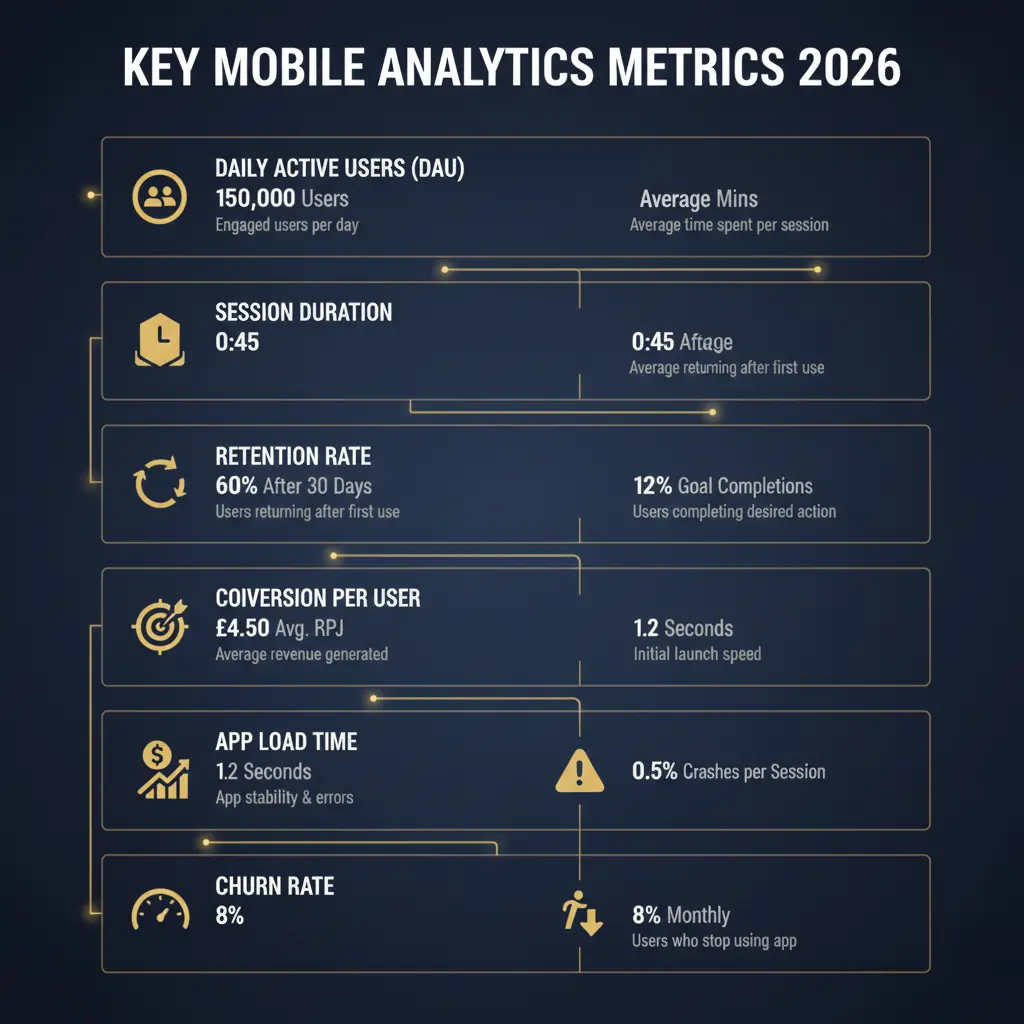
Mobile analytics tools are software platforms that track, measure, and analyze user behavior within mobile applications. They capture everything from basic metrics like downloads and sessions to complex behavioral patterns including user flows, feature adoption, and conversion paths. You need these tools because they provide data-driven insights that inform product development, marketing optimization, and business strategy. Without analytics, you’re making decisions based on assumptions rather than actual user behavior, which significantly reduces your chances of app success in the competitive 2026 market.
How much do mobile analytics tools cost in 2026?
Mobile analytics tool pricing varies significantly based on features, data volume, and business size. Free options like Firebase Analytics offer unlimited basic analytics at no cost, making them ideal for startups and indie developers. Event-based platforms like Mixpanel offer free tiers covering up to 20 million events monthly, with paid plans starting around $28 per month. Marketing attribution tools like AppsFlyer charge per conversion event at $0.07, while enterprise solutions like Amplitude and Glassbox offer custom pricing based on specific requirements. Most platforms provide free trials or freemium tiers allowing you to test before committing to paid plans.
What’s the difference between product analytics and marketing analytics tools?
Product analytics tools like UXCam, Mixpanel, and Amplitude focus on understanding user behavior within your app to inform product development decisions. They track feature usage, user flows, engagement patterns, and retention metrics, helping teams build better products. Marketing analytics tools like AppsFlyer and Adjust focus on attribution, tracking which channels and campaigns drive installs and conversions, optimizing ad spend, and preventing fraud. Many successful companies use both types of tools complementarily—marketing analytics to acquire users efficiently, and product analytics to keep them engaged and convert them to paying customers.
Can I use multiple analytics tools simultaneously?
Yes, and many successful app companies do exactly this. Different tools excel at different aspects of analytics, and using complementary platforms often provides more comprehensive insights than relying on a single solution. For example, you might use Firebase for free basic analytics and crash reporting, AppsFlyer for marketing attribution and fraud prevention, and UXCam for detailed session replays and user experience insights. The key is ensuring your tools integrate well together and that you’re not creating unnecessary complexity or data silos. Start with one or two essential tools and add more as your analytics needs mature.
How do mobile analytics tools handle user privacy in 2026?
Mobile analytics platforms in 2026 have adapted extensively to privacy regulations like GDPR, CCPA, and Apple’s App Tracking Transparency framework. Modern tools offer privacy-preserving measurement techniques, aggregated reporting protecting individual privacy, on-device processing minimizing data collection, and built-in consent management systems. Most platforms support privacy-compliant attribution working within Apple’s SKAdNetwork and Android Privacy Sandbox. However, app developers remain ultimately responsible for compliance. You must implement proper consent mechanisms, provide clear privacy policies explaining data collection practices, and use analytics tools’ privacy features appropriately. Always consult legal counsel to ensure your analytics implementation complies with regulations in all regions where your app operates.
Conclusion
Mobile analytics has evolved from simple app performance tracking into sophisticated platforms powering data-driven product development, marketing optimization, and business strategy. The tools available in 2026 offer unprecedented capabilities for understanding user behavior, predicting outcomes, and measuring change impact with precision.
Choosing the right analytics platform starts with clearly defining your goals, constraints, and how you plan to use data. Different tools excel at different aspects—from product analytics to marketing attribution to technical performance monitoring. The platforms covered in this guide represent leading solutions across categories, each bringing unique strengths making them ideal for particular use cases.
Implementation quality matters as much as tool selection. Following best practices around tracking strategy, naming conventions, quality assurance, and documentation ensures you collect accurate data driving better decisions. Respecting user privacy and complying with regulations isn’t optional—it’s fundamental to sustainable analytics practice.
For app developers, marketers, and product managers in 2026, investing time in understanding and properly implementing mobile analytics tools pays dividends through better user experiences, more efficient marketing spend, and stronger business outcomes. The insights these platforms provide transform gut feelings into data-driven confidence that drives sustainable growth.